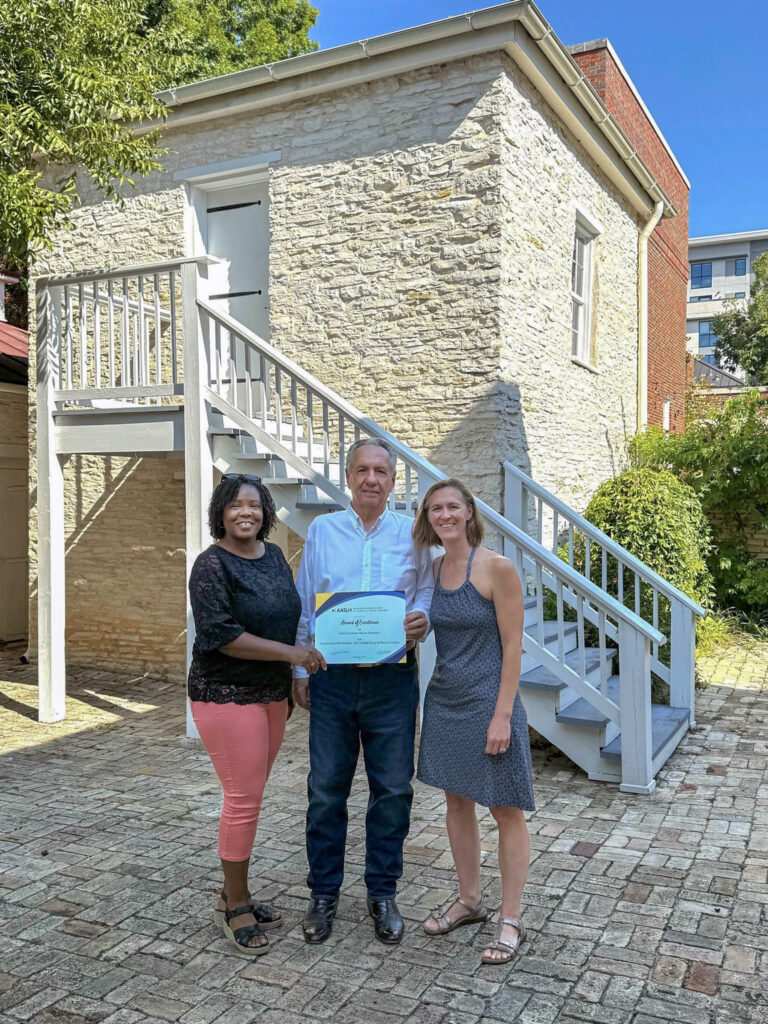
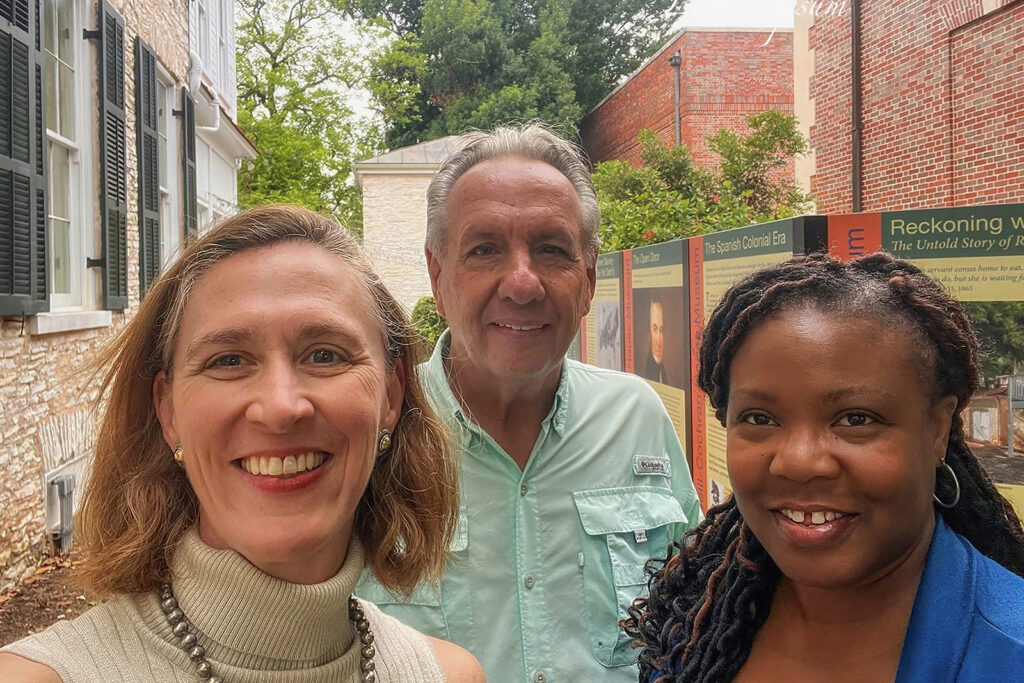
Earlier this month, the American Association for State and Local History (AASLH) presented the Neill-Cochran House Museum with a Leadership in History Award for the completion of Reckoning with the Past, the project to restore and reinterpret Austin’s last intact slave dwelling. There are so many people to share in the acclaim for this groundbreaking, years-long effort. These include the three pictured here: project researcher Dr. Tara Dudley (UT), interpretive planner Ted Lee Eubanks, and NCHM Executive Director Dr. Rowena Dasch.
Learn more about the Reckoning with the Past project here:
For nearly eighty years, AASLH has presented Leadership in History Awards to establish and encourage standards of excellence in the collection, preservation, and interpretation of state and local history in order to make the past more meaningful to all people.
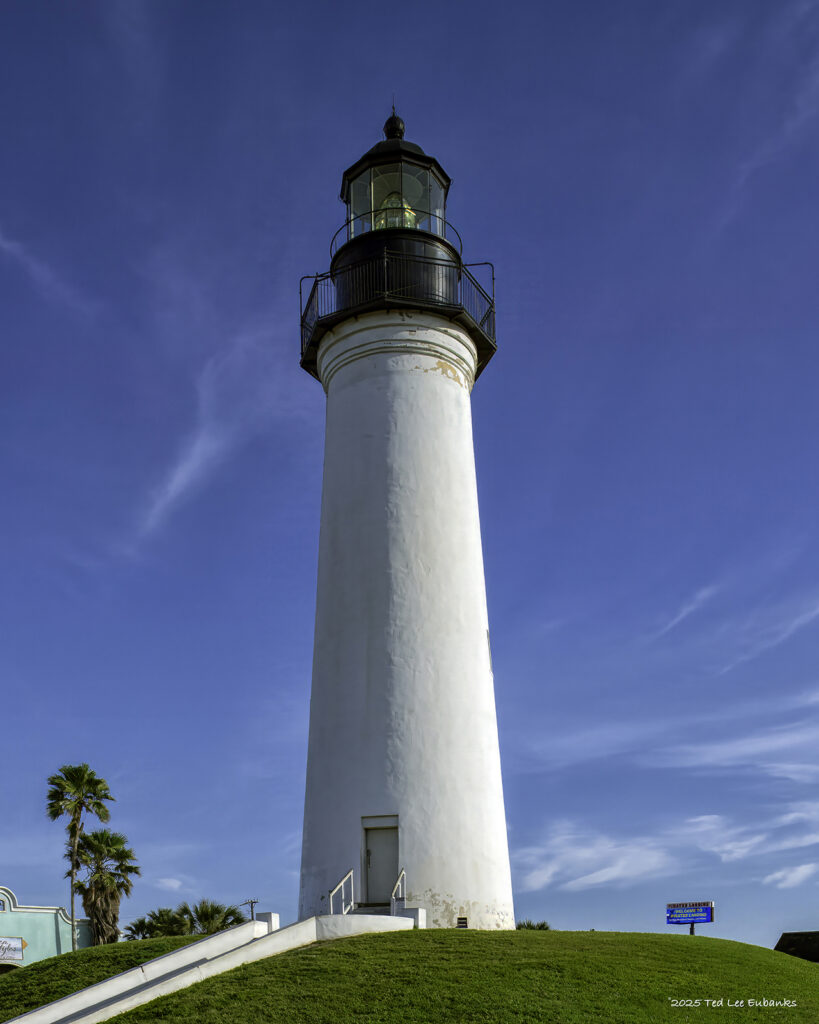
Port Isabel Lighthouse, constructed in 1852. This is the only publicly accessible lighthouse in Texas.
In early March, I spent several days working in Port Isabel on a new Interpretive Master Plan (IMP) for the Texas Historical Commission’s Port Isabel Lighthouse State Historic Site, gathering information and meeting with stakeholders.
I am truly fortunate to be engaged in such a fantastic project in one of my favorite Texas coastal towns with a wonderful group of passionate supporters! This project offers me the opportunity to continue delving into the history of one of the most intriguing (and captivating) areas of Texas – the Lower Rio Grande Valley.
Dr. Tara Dudley (left) and Dr. Rowena Dasch (right) at the Neill-Cochran House Museum
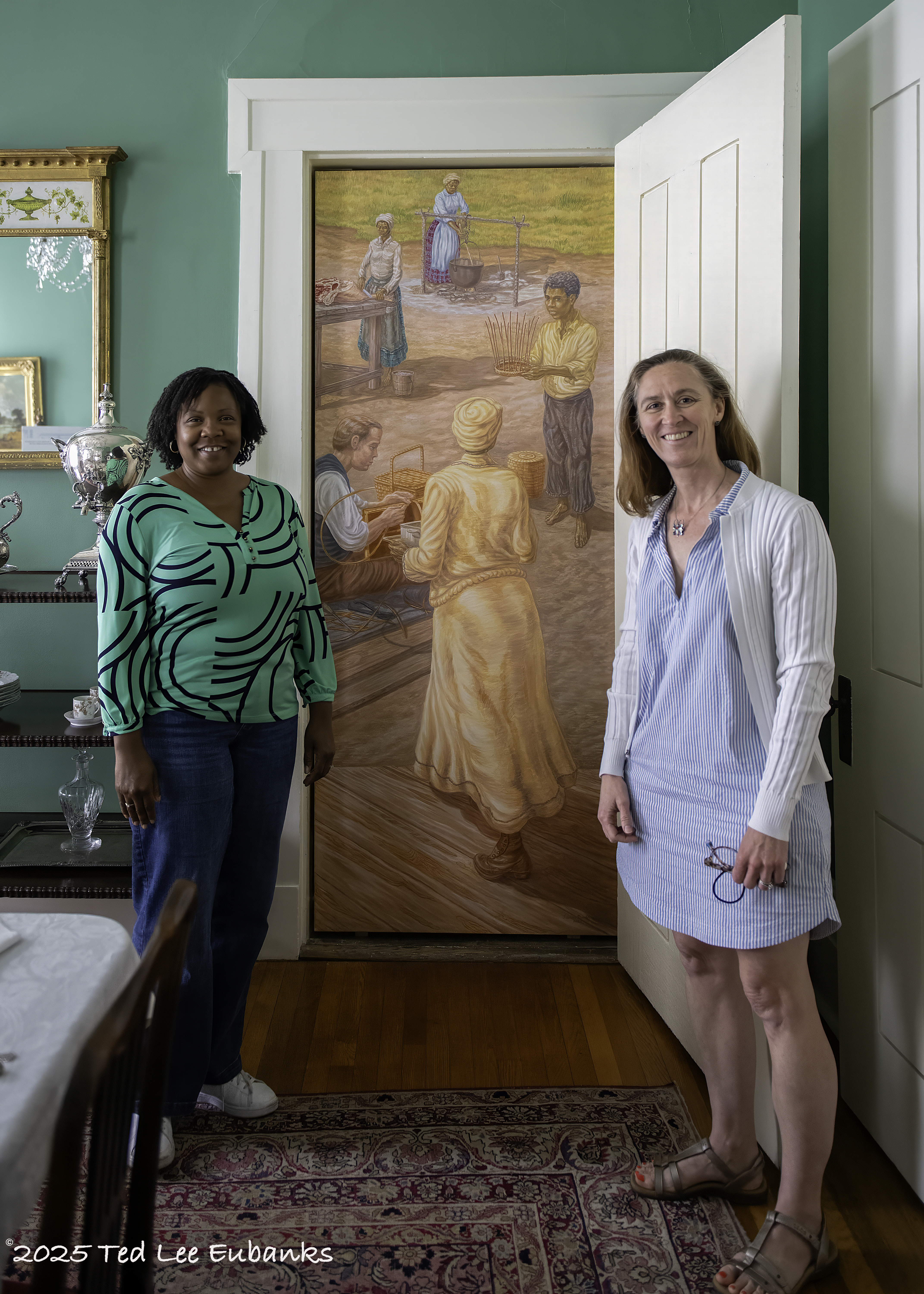
This photo is of Dr. Tara Dudley (left) and Dr. Rowena Dasch (right) at the Neill-Cochran House Museum in Austin. Fermata worked with Tara and Rowena on the restoration and interpretation of the NCHM Slave Quarters, and the installation of three murals in the main house is one of the final steps in this multi-year effort. I have been honored to serve on the team with Tara and Rowena in bringing this history to light.
The murals are by the Austin artist Fidencio Duran, and reflect scenes and activities of antebellum Austin. In this example you see a young enslaved boy, Lamb, teaching a blind man how to weave a basket. Lamb lived in the slave quarters during the period (beginning in November 1856) that the NCHM served the Republic of Texas as the “Blind Institute.” The women in the background are butchering and rendering a hog.
This mural is installed in the doorway that leads to the kitchen. The two additional murals are installed in windows in the main house.
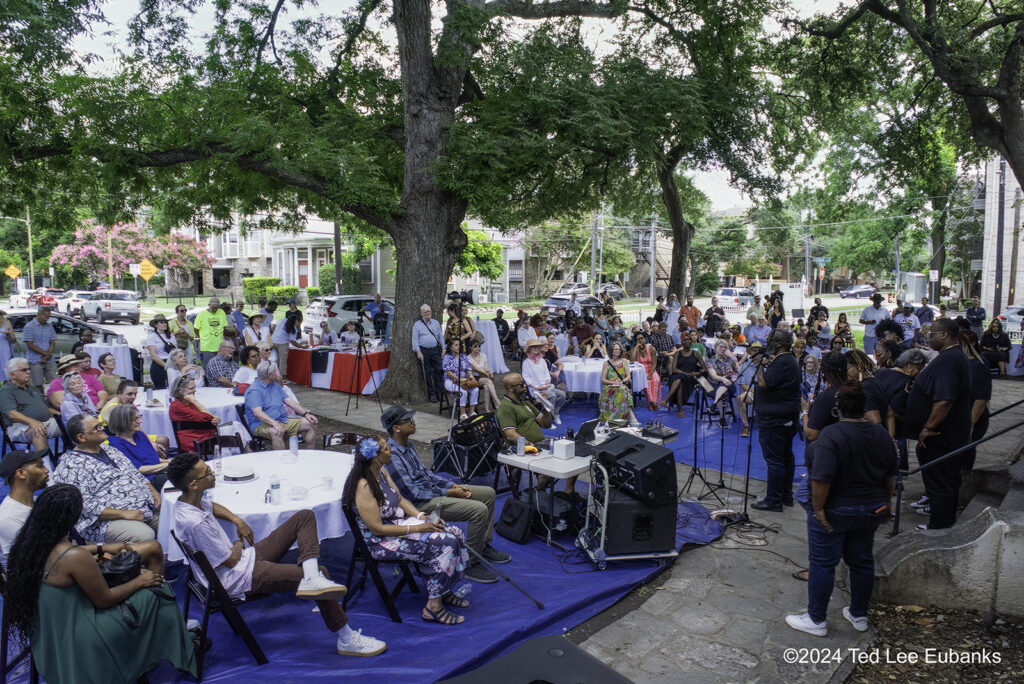
Juneteenth Celebration at the Neill-Cochran House Museum
Saturday, June 22, we celebrated Juneteenth at the Neill-Cochran House Museum (NCHM) in Austin, Texas. For the past 18 months our team has worked on the restoration and interpretation of the slave quarters that is situated behind the main house. Both structures date to the mid-1850s, just a few years after the founding of Austin. This building is the last in situ, intact slave quarters remaining in Austin.
Although the house museum is located on a relatively small parcel of land, and it is now surrounded by the West Campus of the University of Texas, we were still able to develop an interpretive plan that tells the 500-year history of enslavement in Texas. The interpretive tours that we structured range from impersonal and didactic materials at the beginning, to a personal/dialogic approach when the tour finally ends at a contemplative garden. After Michael Barnes’ article made the front page of the Austin American-Stateman (and was subsequently covered by several Gannett papers around the country), the Saturday event attracted hundreds of people from throughout the community as well as central Texas. And, in a city with a declining Black population, 40-50% of those who attended the event were African-American.
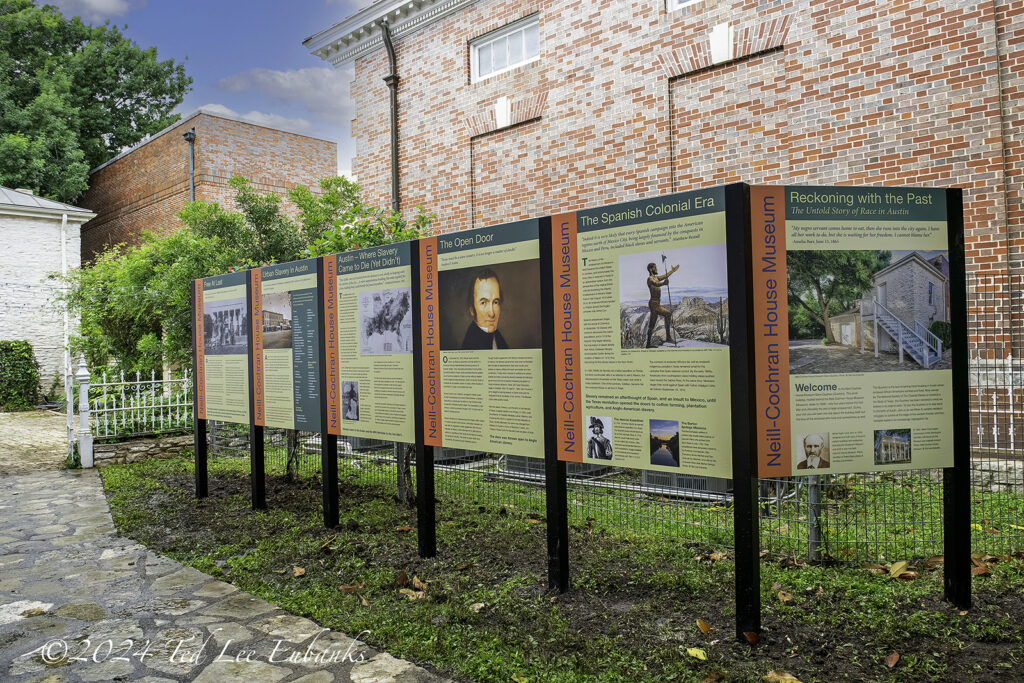
Slave Quarters Interpretive Panels
[I will also add that in a time when certain Austin park events are increasingly expensive and exclusive, the NCHM provided the day’s events (including lunch) for free.]
The NCHM is an excellent example of how a rather traditional house museum can redefine itself through strong leadership, key partnerships, a bold (even risky) interpretive strategy, and truth telling.
Thanks to Dr. Tara A. Dudley, Assistant Professor in The University of Texas at Austin School of Architecture, and Dr. Rowena Dasch, Executive Director at the NCHM, for being such incredible partners and leaders in this effort.
From left to right: Dr. Rowena Dasch, Ted Lee Eubanks, and Dr. Tara Dudley
For those interested in learning more about the house museum, here is a link to the website: https://www.nchmuseum.org/
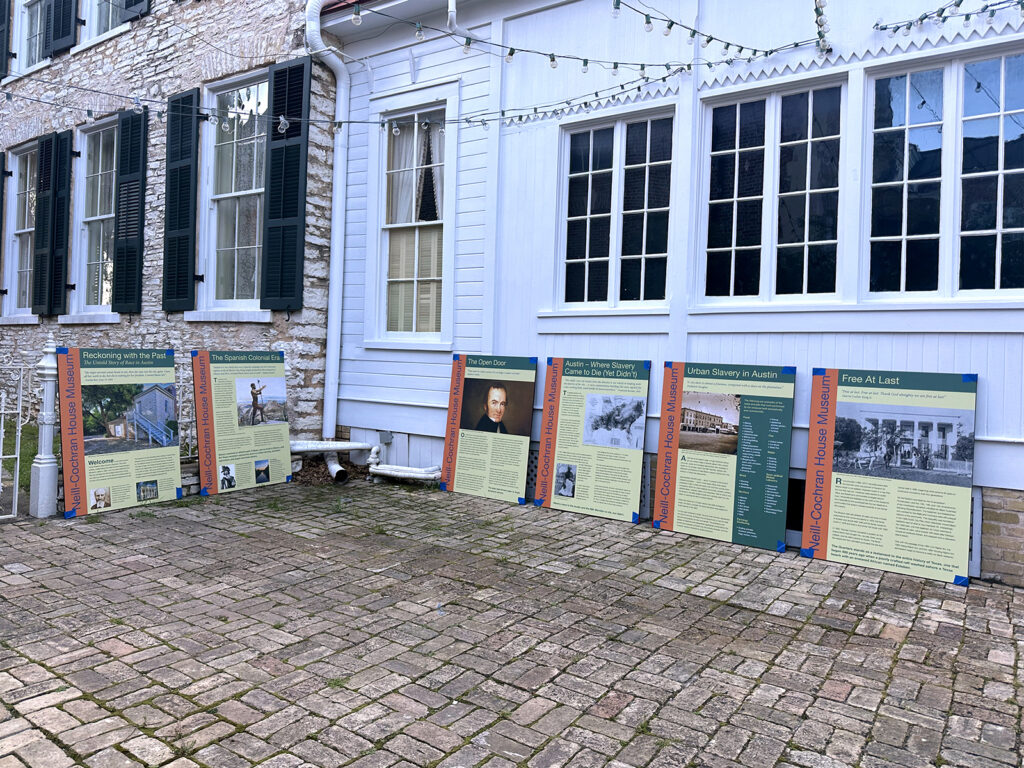
Today, April 3, we held a workshop on interpreting enslavement for the Texas Historical Commission’s (THC) Real Places conference. The workshop convened at the Neill-Cochran House Museum in Austin (NCHM), and the panelists included Kristin Gallas of Muse Consulting, Dr. Rowena Dasch (executive director of the NCHM), Dr. Tara Dudley (UT), and myself (Fermata Inc.). THC’s Charles Peveto moderated our workshop.
We were able to unbox the six interpretive panels that Fermata designed for the newly restored NCHM slave quarters for the first time. The installation of the panels will take place on April 15.
Thanks to all who attended the workshop, and for all of the input from and participation by the attendees.